Thursday, 7 April 2016

The Peninsular project part 6.2 The battle of Evora continues

Welcome back part 2 of the battle Firstly thanks to all that took the time to follow the first part of the battle. The second part continues with the French more infantry arriving at the end of game turn 5. General Lision orders a full advance at the start of turn 6 he also receives another unit of dragoons to boast his force.

The battle at the end of turn 5 

Turn 6 and we see the allied artillery continue to fire at the French but both fail to hit their targets. The Lisbon police are caught by the dragoons and the survivors flee, unfortunately the irregulars fail their charge command and stay hidden in the woods. The Hanoverian line infantry hold their ground and fire at the hussars, but this doesn't stop them and they charge the Hanoverian's.

General Lision watches the road as the 5th dragoons advance towards him, he orders them to take the right flank and advance.

The dragoons move out
The Hanoverian line stand their ground, and fire at the hussars but they fail to stop them.

The Portuguese cavalry fail their morale, and run.

The irregulars card is drawn and they check their command to charge and fail the dice roll, and stay hidden in the woods.

The Spanish artillery start to withdraw from the ridge, and move towards the second defensive position.

The Lisbon police fail their rally test and flee.

Turn 7 starts with more French arriving on the battle field, two battalions of the 86th line and the 5th dragoons. 
General Lision directs the new arrivals.

The irregulars surge out of the woods and attack the dragoons, to late to save the Lisbon police who were caught by the dragoons the the few remaining police flee the field. 

The Spanish artillery starts to withdraw from the ridge

The 4th dragoons withdraw from the irregulars, and what is left of the Lisbon police also withdraw.

General view of the battle at the end of turn 8. The French have a hold on the Spanish ridge and the Spanish are withdrawing to the second defensive position.

The Portuguese line are withdrawing towards the walled gardens.

The Spanish hussars force the Hanoverian line back 

General view of the battle at the end of turn 9. The French army is advancing with the combined grenadiers leading the assault on the road.

The Portuguese line infantry are withdrawing to the walled gardens 

The Spanish line fall back before the 58th line infantry

The French are in position for the final assault

Its all confusion as the allied try to withdraw in some kind of order

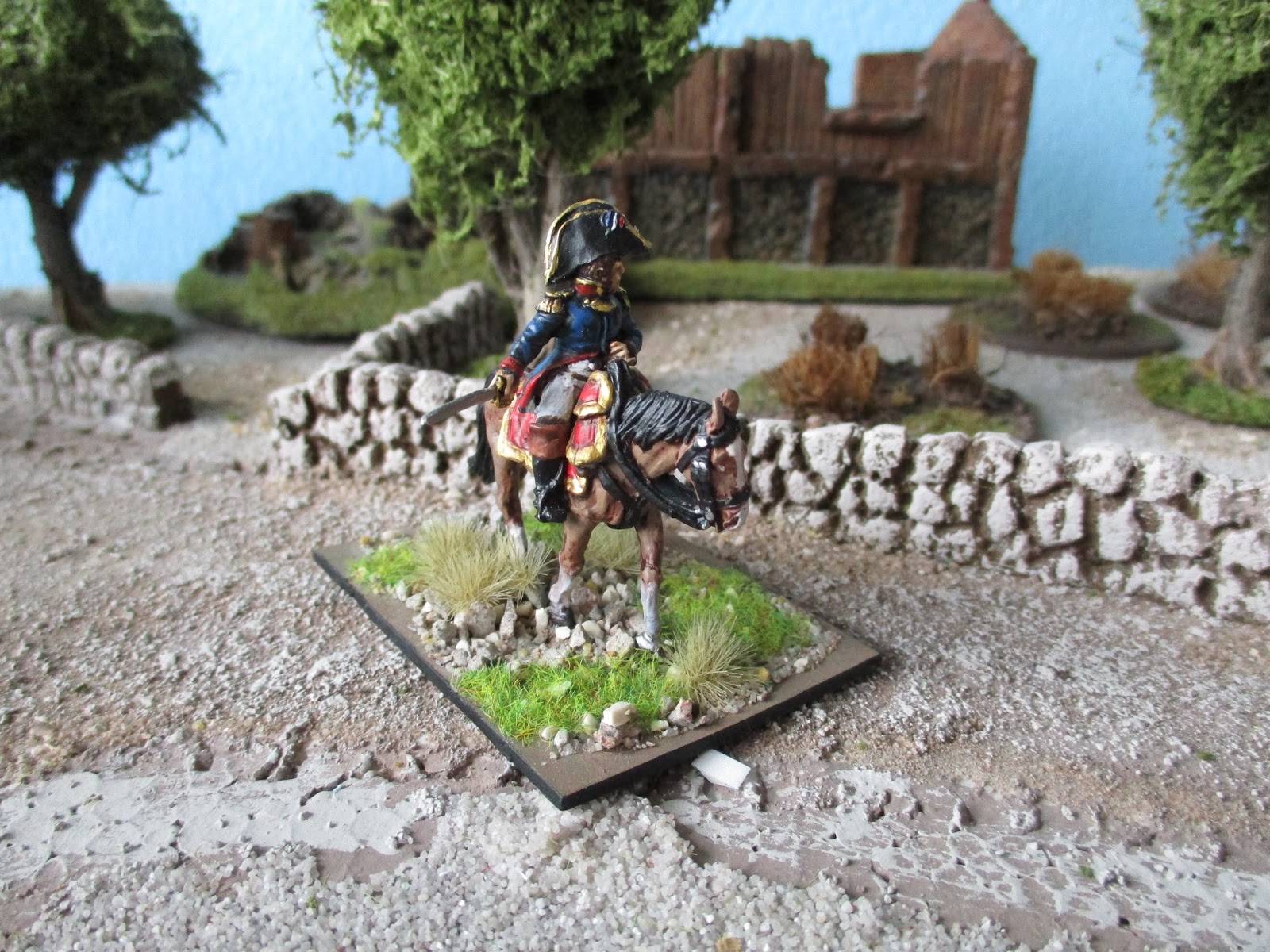
General Leite gains control of the Portuguese just in time and garrisons the road and the walled gardens, and awaits the French.

Unfortunately the Spanish infantry fail there hold command and continue to withdraw.

The battle field at turn 10

Finally the French artillery has arrived, someone is in big trouble. 

The Spanish infantry are still withdrawing and the hussars are following them off the table. The militia are moving over to cover the gap.

The leading French infantry are pounded by the allies artillery but still the advance.

General view at the end of turn  

The militia and the 58th rush for the wall.

The Portuguese line brace themselves in the walled gardens.

The grenadiers charge the walled gardens, the Portuguese put up a good fight.

The militia are smashed by the 58th line and are forced from the wall line.

General view at the end of turn 13 the allies are just about holding on.

Turn 14 and the grenadiers are in the wall garden the Portuguese line are in fall retreat.

The allies right has crumbled.

The allies left has also fallen and the battle is over.

General view of the end of the battle, what is left of the allies run for the city, the French have won, but it wasn't a walkover. 

Well that was a battle, the French moved forwards all the time and had some early success driving the allies from the ridge and the road. The irregulars made an appearance and drove off the outnumbered dragoons, but to late to help their cavalry. the French then moved onto the attack again and drove the allies from the second position, but only after a stiff fight for the walled garden. The 58th line infantry lead the assault like they did in history and took the ridge and also captured the walled area on the allies left. A really enjoyable game thanks to all who followed and commented on the first part hopefully the second part was also enjoyable to read to. 

That's it for the the campaign so far in part 7 the British finally make it to the campaign, till then my friends. 
  

Monday, 4 April 2016

The Peninsular project part 6.1 The battle of Evora

In the first part of part 6 of the project, I'm going to re fight the battle of Evora fought on the 29th July 1808. As this is a large skirmish battle I'm going to post it in two part mainly because if i don't most readers will find it to much for one post. ( i know i did )
So the first part will cover turn 1 to 5 and part 6.2 will follow on with turn 6 to the end.

The battle sketch showing the layout of the battle field. The allies can be seen in the for ground, and the French can be seen advancing up the road towards Evora.

A quick recap 
The battle of Evora was the result of general Junot's desire to keep the main route into Spain open. He had dispatched general Lision with up to 7'000 men to capture the city of Evora which had a garrison of Portuguese and Spanish regulars. Once Evora had been garrisoned Lision was to advance onto Elvas. 
For my re fight i have given the French the task of clearing the allies from their defensive positions. The allies have the option to withdraw to a second position. once the allies have been forced from the second position they are defeated and the city is lost.
If they manage to hold their second position then the French have been defeated and Evora has been saved from its terrible fate.

To make things a little less one sided, i have given the French only 3 of their units at the start of the game. the French have also been given the assault command that means that they will advance on the enemy once they are on the table.(Lision was confident that he could carrier the position especially, as the allies had chosen to fight him in the open rather than from behind Evoras walls.)
The battle starts with the allies holding their first defensive position, the irregulars are hiding in the woods, ready to pounce on the French flank. The Portuguese regulars are formed up on the right with their artillery and the volunteer cavalry behind in support. The Spanish artillery is next with the Spanish regulars holding the left flank and ridge line. The Spanish hussars are stationed behind the Spanish infantry. The militia are on the road to the rear.

On the other side of the battle field, general Lision is marching along the road towards Evora. With him are the 4th dragoons they will take up a position on the French left and flank the Portuguese infantry. The 58th line infantry and the Hanoverian are next and will form up on the other side of the road, and attack the Spanish held position on the ridge.
The rest of Lision's force is strung out along the road, and will have to be diced for.
From game turn 3 i will roll a D6 for each of the remaining French units, the results will determine which turn the units will arrive on the battle field.

For each unit roll a D6 results as below:
1= turn 4                             4= turn 7
2= turn 5                             5= turn 8
3= turn 6                             6= turn 9

Normal command tests for advancing will be used, but to reflect the shaky morale of the Spanish hussars that in the historical battle, road off into the sunset, before they were contacted by the enemy will have to roll a one off D6 morale test the first time they are ordered to advance on the enemy.

Hussars morale test roll a D6 results as below:
1 or 2  and the Hussars brake and run 
3 to 6  and the hussars draw their swords and advance.

Start of the battle and the units are placed on the table. 

The allies in the first defensive position

The first of the French appear on the battle field

    The battle field at turn 1 the main allied force is in their first position the second line of defence is either side of the militia unit base on the road in the rear.

Spanish artillery open fire on the dragoons on the road but miss. The card behind them is their activation card.

The Portuguese artillery also fire on the dragoons and they also miss, For each phase, each unit on the table has a activation card which is drawn from the deck of activation cards. 

The dragoons move through the trees to flank the allies.

general view of the battle start of turn 3

General Leite watches as the dragoons move on his right flank. He orders the Lisbon Police to advance on the dragoons.

general view of the battle start of turn 4

The Lisbon police move towards the dragoons 

The dragoons can see the enemy cavalry moving and form line.

More French infantry appear on the battle field General Lision orders them on. 

General Leite orders the Spanish hussars to move over the ridge and attack the Hanoverians a D6 roll and their off sword in hand towards the enemy, but will they charge home?

The dragoons pass the order to charge home but the Lisbon police fail their counter charge order.

general view of the battle start of turn 5

Cavalry fight. the dragoons have the advantage as they charged. 

The result of the fight the dragoons win the first round 4 hits to 1. The dice indicate hits on the figure as these are both skirmish single figure units For each hit on a target a D6 is rolled to see how many wounds are cused that round. Single figures have a maximum of 3 wounds

The battle at the end of turn 5. The dice behind the unit bases in the background are for morale damage as units count hits as morale damage in combat.
a quick recap of the action so far. The Spanish still hold the ridge, and with the hussars about to appear on the flank of the Hanoverian the first French assault is in the air. When the hussars move the Hanoverians will have to take a morale test, at minus 1 to see if they stand or run, on the ridge the Spanish artillery are down to morale damage and will have to test when their card is draw to see if the continue or start to withdraw. The cavalry battle on the right is about to get interesting a morale test is needed for the Lisbon police cavalry and see picture below there is a nasty surprise awaiting in the wood for the dragoons in turn 6 (as long as they pass their command to charge test)

irregulars in the woods 


well that's it for the first part of the battle of Evora  thanks for hanging in there it's been a real test of the rules and my sanitey but both are holding out, part 2 of the battle will follow on from turn 6 till then my friends

Friday, 18 March 2016

Peninsular project part 5 The campaign continues

With the news of General Loison battered force making it back to the fortress of Almeida on the 1st of July after his attempt to crush the rebellion around Porto. It was know clear to Juont that the north of the country was finally lost for the moment. All around Portugal towns and city's were rising up against the French, around the same time as Loison was fighting, the towns of Vila Vizosa and Beja to name but two also rebelled, although most of these uprisings were put down, it was a worrying development for the French. On the 27th of June the coastal fortress of Santa Catarina was captured by the students of the near by Coimbra university lead by Bernardo Zagalo, after the French garrison hand been surrounded and almost starved out. This small fort was to have big repercussions, as it made the landing of the British army on the 1st August possible. Elsewhere the French marched on Alcobaza and Leiria taking both towns after stubborn resistance from local forces, but the situation was less than stable for the French. General Junot back in Lisbon decided to regroup his men around the city. he ordered all possible troops to march on Lisbon and to leave men in the fortress of Almeida, Elvas and Peniche on the coast. French troops were on the move again, marching in the direction of Lisbon, leaving a trail of devastation in their wake, burning and plundering their way back to Lisbon. By mid July most of the troops had gathered around the area of Lisbon, and it was around this time that Junot received more bad news, as British transport ships had been seen along the coast, and rumours were abound of British troops landing. Unbeknown to Junot on the 19th of July general Dupont hand been beaten at the battle of Bailen, and forced to surrender on the 23rd nearly 18'000 French troops had laid down their arms never since the Revolutionary wars, had a French army been beaten on the battle field.

Now that the possibility of the British were getting involved, together with having to face  increasing numbers of Portuguese troops, Junot know looked to the east, and his lines of retreat, if things went wrong he didn't want to be trapped in Portugal. Junot's  best route out of Portugal was the road to the fortress of Elvas but this was straddled by the town of Evora. With its contingent of Spanish and Portuguese regular troops it might prove a problem, so Junot once again sent General Loison with around 7'000 men to take the town of Evora and open the line of retreat to Spain.
In Evora Major General Francisco De Paula Leite an ex naval officer was in command of a mixed force of Portuguese and Spanish regulars and militiamen, he had some cavalry and artillery with him as well as large numbers of poorly armed peasants and townsman.

The next battle of my peninsular project will be to re fight the battle of Evora. 29th July 1808.

The French 
General Loison force was again made up of veterans, and had both line and light infantry as well as Dragoons and artillery in support.

General Loison
The forces involved:

one battalion of:
12th light infantry
14th light infantry
58th line infantry
1st Hanoverian Legion

two battalions of:
86th line infantry
Reserve Grenadiers

4th provisional dragoons
5th provisional dragoons

8 field guns

i have used the light infantry bases i used in game two the retreat from Teixeira to represent the light infantry, in this battle. I will need to paint another six light infantry skirmishers.

The 12th light with their skirmishers

The 14th light with their skirmishers

For the line infantry i have used some of the bases i already have I'm not going to give the line infantry bases any skirmishers, I'm going to give the light infantry that job. The figures are a mix of Victrix, Perry and warlord.
The 58th line

The two battalions of the 86th 

The Hanoverian uniform were French in the style, but with a red coat for these i used Warlord games early French infantry they come with the long coats and the knee gaiters. as worn by the Hanoverian.

The Hanoverian Legion 

For the reserve Grenadiers i used a mix of Warlord games, Victrix and Perry miniatures. Technical i don't think the two battalions would have had carried eagles, but i couldn't help myself, and this dose mean i can use them for other French units in later games.

The two reserve Grenadiers battalions

The 4th dragoons 5 single figures

The 5th dragoons again with 5 single figures
Again I used Perry plastic dragoons box set For the 4th dragoons. I am also going to use one base to represent the French artillery.
The French artillery 


The Portuguese and Spanish  
General Francisco De Leite force was made up of both Portuguese and Spanish regulars, as well as militia and irregulars. He also had cavalry and artillery with him.

General Francisco De Leite

The forces involved:

3rd Portuguese infantry battalion
3rd Portuguese artillery 
Portuguese volunteer cavalry
battalion of Spanish regular infantry
Maria Luisa Spanish hussars
Spanish artillery 
several thousand irregulars armed with hand weapons


For the Portuguese regulars i have used the same battalion from the retreat from Texira battle, again I'm going to give them a full battalion, but no skirmishers.

The Portuguese regulars 

To represent the 3rd Portuguese artillery I'm going to use the artillery base from the earlier game.
The Artillery 

For the Portuguese volunteer cavalry i have found an illustration depicting the Lisbon police who were originally attached to French troops, but most absconded. so i thought i paint some up to represent the volunteers. i used a mix of Warlord games chasseurs  and Perry carabiniers helmets.

The Volunteer cavalry 

For the Spanish regular infantry i have used eagle miniatures Spanish infantry. I have gone for the distinctive Spanish white uniforms with red collars cuffs.
The Spanish regulars regiment 

To represent the Spanish hussars i used Perry miniatures hussars box set. The Maria Luisa regiment wore the mirliton cap with sky blue pelisse and britches, the illustration i found shows them not wearing the red dolman  or outer jacket so i painted mine up without theirs.

The Maria Luisa hussars in their dashing uniform

 For the Spanish artillery i have used Eagle miniatures Spanish gun crew.

The Spanish artillery crew hard at work 

For the purpose of the game i have given the Portuguese a unit of militia not actually present in the  historical battle but i wanted to give the allies a bit more fire power as well as having the hand weapon armed irregulars 
The militia and the irregulars making up the numbers.

The historical battle for Evora
Historically the battle didn't go well for the allies, much to the surprise of the French they were drawn up out side the town gates. The assault on the allies was lead by the 58th line, who broke the Portuguese and Spanish line. The Maria Luisa hussars road off in panic before they were contacted. The Spanish line regiment put up a stubborn fight and retreated well, with most of the Spanish withdrew to Olivenza, the rest ran for Evora, the town fell to the second assault, the first being held, the fighting soon spread into the town. 
The town was sacked by the French and the slaughter was terrible. near by towns submitted rather than suffer the fate of poor Evora, but after the shock came the determination of the people to fight the French and drive them from Portugal.

Set up
For my replay I'm going to give the allies a better defensive position and allow them to retreat to a second position. I'm also going to handicap the French by having them arrive onto the battle field in drips and drabs.

To make things a bit more interesting and less one sided for my re fight, the allies will be defending a ridge line and their flank will be covered by a wooded area and a ridge. The second position is more open with some light woods on one flank and a few building and walls and fields on the other. Loison will approach from the west along the road leading to Evora, with him will be the Hanoverians and the 58th line and the 4th dragoons this is all the troops he has at his disposal at the start of the game. This will make things a little difficult for the French at the start of the battle, as the army is strung out on the road behind the vanguard i will roll a D6 for each of the other units to see when they will appear.

The battle sketch. Evora can be seen in the back ground. The first of Loisons troops are taking their position others are just appearing on the road. The allies can be seen ready to give battle in their first defensive position.

Well that's if for know the full set up and the battle report to follow in part 6 till then my friends.


Friday, 26 February 2016

1799 AND ALL THAT small actions in Britain with Smooth and Rifled skirmish Rules

For a few months i have been playing a what if campaign set in Britain using paper armies playing small action using Smooth and rifles skirmish rules, with the empathises on small political factions fighting against each other as well as the government forces.  when we left the campagin, we last sore the BR (the British Republic) gaining control of Salisbury. with the local yeomanry falling back eastwards. what is this Tosh i hear you say.

INTRODUCTION
Allow me to explain, our campaign is set in a fictional Britain of 1799. Were the country has exsperianced some polictical problems, and is sliding into a civil war. With many different polictical factions ving for control of cities and areas around the country the BR British Republicans, have amerged the victors in a nasty but thankfully short inter war.  The BR has now over 2000 men under arms and has consolidated its control of the country side around Salisbury and is now on the move westwards, but i get ahead of myself. Back in the early parts of 1796 the French Republic is fighting for its life. With Napoleons glorious campaign in Italy, being slowly unravelled by the Austrians and Russians. The Irish and French have been defeated in Ireland, and how long would it be before the British committed more than just there navy against France. It was the Republics master spy Roshurpear,  who's plan was to cause problems in Britain in the hope that the British government would be forced to concentrate on affairs at home and hopefully force them to use their military at home and not against the French 'for a time at least'. So he  put his Grand deception together. he would use his net work of spy's in Britain, to start rumours and descent. the seeds were sown.
soon small numbers of demonstrations started, ans polictical movements grew around the country, some of the demonstrations tured violent, and were soon put down by local forces, one in Salisbury was put down brutally, this made thing worst, numbers grew in the BR mainly around the west and north west. it wasn't long before minor skirmishers were fought between the BR supporters and the local government forces as well as skirmishes against smaller short lived polictical oposition.

We picted up the  paper work from the last outings and a quick read through shows. The BR had grown in numbers helped with the supplies and weapons smuggled in from France by privateers, they had around 2'000 men under arms divided into 3 ad-hock battalions.

1st blue battalion of the BR
1st red battalion of the BR
1st green battalion of the BR
the colours of the battalions come from the colour of the collars that are sown onto the solders civilian coats and some French uniforms smugglerd in.
There is also a small cavalry contingent under the command of captain James Collins around 20 strong.
this brigade is under the command of General John Painless.

Last time:
 There had been several skirmishes around the west country, which the local yeomanry namely the Monmouthshire fencables and the Monmouthshire lights had contained, but on August 17th some 1'800 men of the BR well armed but raw, ran a running battle with the hard  pressed and out numbered Monmouthshire's who were pushed back to the out skirts of Salisbury, which eventually fell to the BR after a most spirited defence, a day later. Rumours of French regulars in Ireland, and the news of the BRs success at Salisbury prompted the Government to call back some of the regular army. (Roshurpear plan is working). At present the only regulars available to the Government is the 2nd battalion of the 28th foot who are at Deal awaiting transportation to the Caribbean. They have been dispatched to the west under the command of colonel William Beards. together with a two troops of hussars and a small detachment of artillery. the only loyal troops in the immediate area around Salisbury are the survivors of the Monmouthshire light's under a captain Travolls, he has been shadowing the BR troops movements. a 1'000 strong force of the BR made up of the 1st red battalion and some others with a troop of cavalry has moved west with the intentions of seizing a port so that the troops in Ireland can be shipped over to Britain. captain Travoll has sent a dispatch to London to ask the government to make all hast in stopping the BR before the regulars can come to there aid.

Or first action of the session will be when a BR patrol bumps into one of the Monmothshire lights advance patrols. for this action we are going to use smooth and rifled skirmish rules by                .
The forces involved and there S&R stats

Detachment of 1st red battalion BR
AV=2/3/4;  C=3
13 militiamen          smoothbore musket (20/2) bayonet
1   NCO (leader)   smoothbore musket (20/2) bayonet

Detachment of Monmouthshire light
AV=1/2/3;  C=4 LIGHT
6 privates              smoothbore musket (20/2) bayonet
1 NCO (leader)     smoothbore musket (20/2) bayonet

we will be playing the game once the old generals can get together

hoping to post the next instalment of 1799 AND ALL THAT soon.
Till next time.